Which TVs and speakers work?+
You need a Google Cast-enabled TV, a connected Chromecast or
Cast receiver, or a Cast-enabled speaker. Not every smart TV
supports Google Cast. Your device and TV or speaker must be able
to communicate on the same Wi-Fi.
Does it work on Mac, iPhone and iPad?+
Apps for all three devices are in preparation. Mac targets macOS
14 or later; iPhone and iPad target iOS and iPadOS 17.4 or
later. Mac will launch first, with mobile to follow when ready.
Downloads are not yet available. Pricing and dates will be
announced later.
How does picture quality differ by device?+
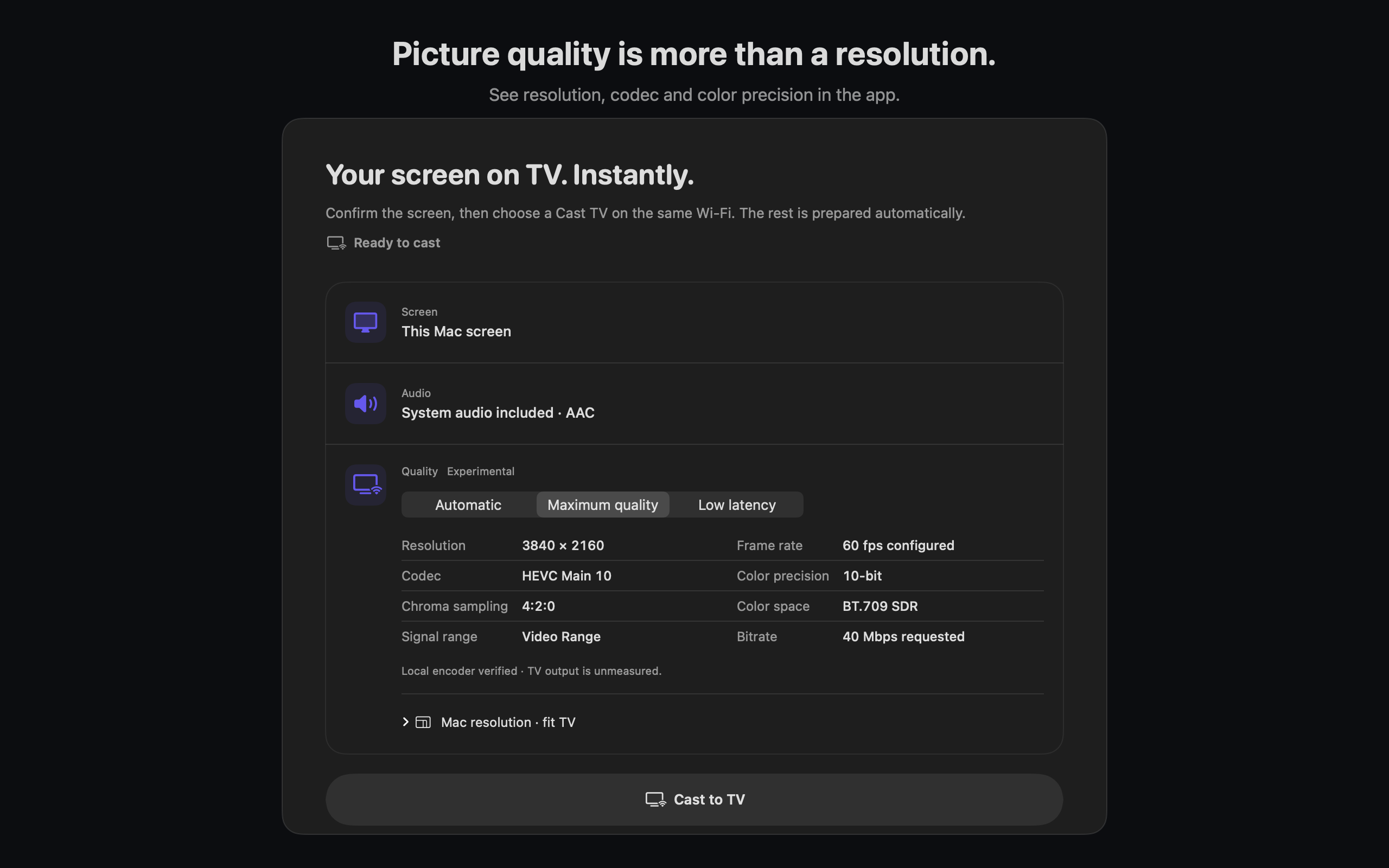
Mac offers Automatic, Maximum quality and Low latency options.
Experimental Maximum quality requests 4K60 and HEVC Main 10,
subject to your TV’s codec support and network. iPhone and iPad
use sender settings up to 1080p 30fps, adjusted for device
temperature. 10-bit does not mean HDR. The current color space
is BT.709 SDR with 4:2:0 chroma sampling.
Can I watch films and streaming apps?+
You can share content that permits screen capture. DRM-protected
video may appear black or its audio may not be shared. The app
does not remove these restrictions. Casting adds latency, so it
may not suit games that need fast reactions.
Will it work in a hotel or with a VPN?+
It can connect when the network allows local devices to
communicate. Hotel and guest Wi-Fi isolation can prevent TV
discovery. If you use a VPN, check its local network access
settings. The app does not provide a VPN or video content.
How do I start and stop a broadcast?+
On iPhone and iPad, choose a device in the app, then start the
system screen broadcast yourself. If the system broadcast
indicator remains after stopping in the app, end the broadcast
in the system picker too. A broadcast may include notifications
and other app screens. The microphone is off by default.